New creators
At Museum Speelklok, we also provide space for emerging creators and music installations. These local and international makers draw inspiration from the music and technology found in the museum.

2025
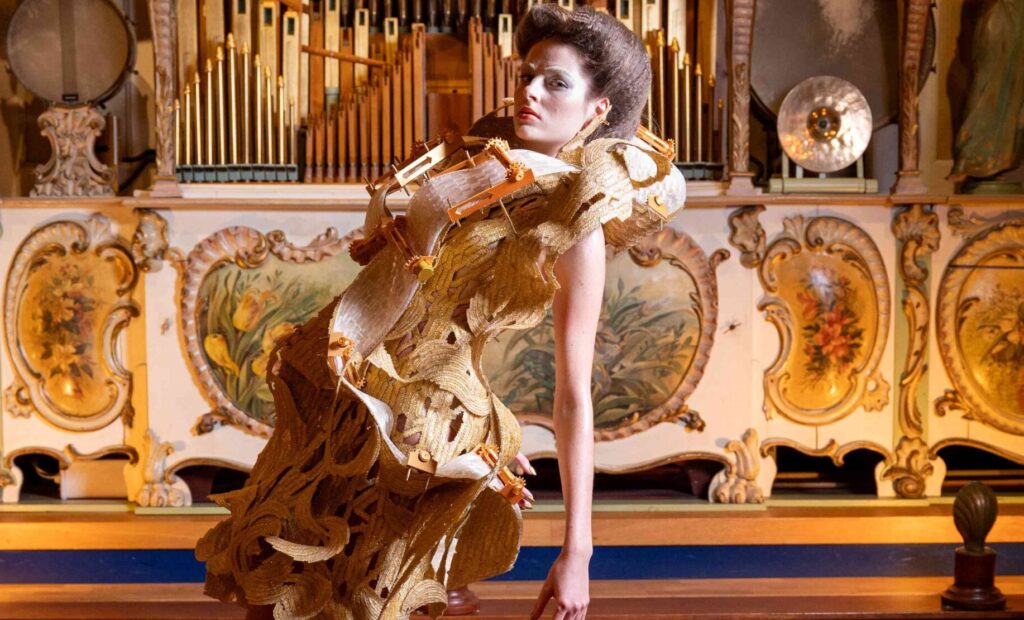
The musical couture dress AU-2-MATERIA by Maartje Dijkstra and Beorn Lebenstedt was on display at Museum Speelklok from October 20, 2025, to November 30, 2025. The dress is inspired by the Royal Clay Clock, an important highlight of the museum’s collection.
The installation consists of a golden dress and a transparent over-dress. It controls a ribbon with a musical composition by Beorn Lebenstedt. The ribbon moves around the dress like an organ book. New technologies form the basis of Maartje Dijkstra’s creations. Unique to Maartje’s work is that she prints the fabric of the dress with a 3D pen, a pioneering, labor-intensive, and costly process.
In November, Maartje Dijkstra and Museum Speelklok launched a crowdfunding campaign together. The funds raised covered the final part of the dress’s development.
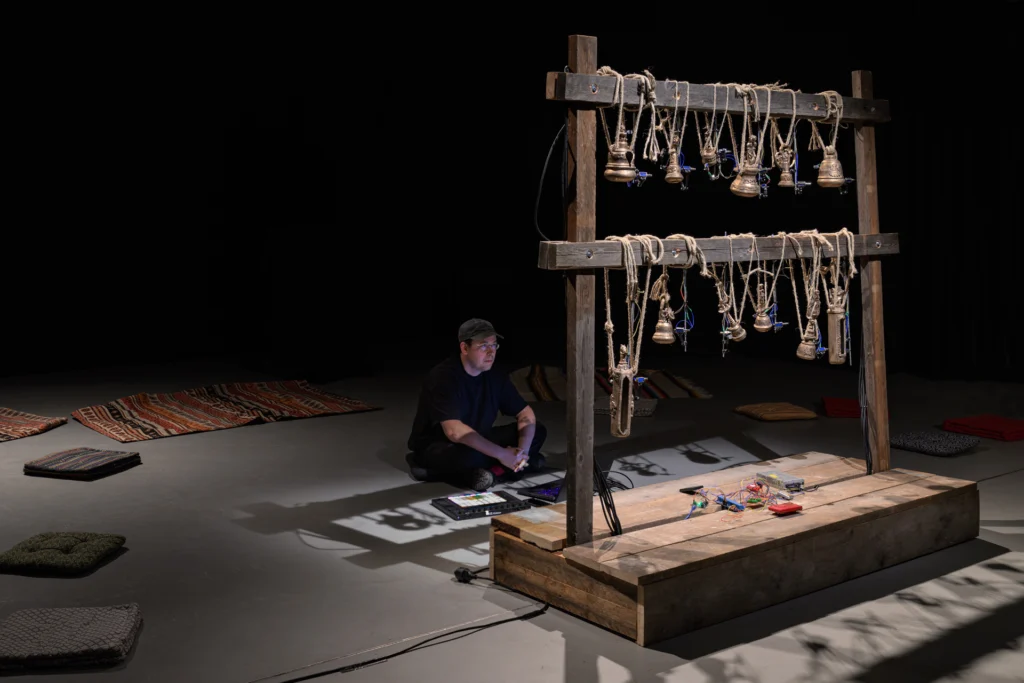
From April to September 2025, artist Thijs Jaeger presented a self playing instrument and artwork at Museum Speelklok. Birth-Elements-One-World is an spectacular piece that features a wooden structure with a series of handcrafted bronze bells, created using a combination of 3D-printing techniques and hand-sculpted wax molds. Just like the instruments in Museum Speelklok, Jaeger’s creation can play automatically – powered by a built-in drum computer – but it can also be played live by the artist himself.
Thijs Jaeger draws inspiration from the temple bells found in Hindu and Buddhist traditions, incorporating his personal search for connection to his Indonesian heritage. He discovered that temple bells in Indonesia serve as a way to connect with ancestors. The layered rhythms and haunting ethereal sounds of his instrument are also reminiscent of traditional Indonesian gamelan orchestras. Through his work, Jaeger seeks to find balance – between the digital and the human, and between the past and the present.
In addition to the instrument, Jaeger has created a new artwork for Museum Speelklok: a gunungan. In Javanese and Balinese culture, the gunungan – a colorful, fan-shaped figure – plays an essential role in wayang performances. The gunungan symbolizes both the beginning and end of a story and helps express the emotional depth of the performance. In his artwork, Jaeger includes symbols that reflect his personal connection to his Indonesian heritage.
2023
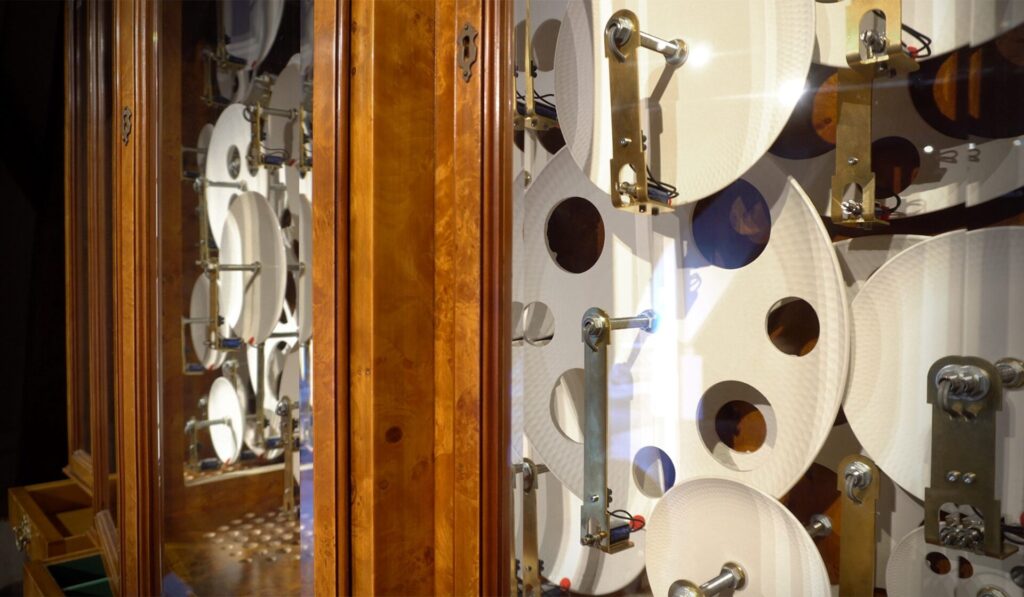
Jelle Mastenbroek exhibited two sound installations in the exhibition ‘Maak ‘t Even’ from December 15, 2023, to September 8, 2024. For the Porcelain Piano, Mastenbroek drew inspiration from the museum’s collection. The artwork combines two familiar household classics: a china cabinet and a piano. The 48 porcelain plates each have their own note and are played by the piano system, allowing visitors to program music for the porcelain piano!
The porcelain piano was acquired by Museum Speelklok: this is the first time that a contemporary artist’s work has become part of the museum collection.
His sound installation Verwarrend Verlangen (Confusing Longing) consists of an arrangement of everyday objects, all of which are used as sound sources. Solenoids, small devices that convert electrical energy into mechanical movement, tap against the objects. These solenoids are powered by a small computer system containing a code. The code is actually the melody.
With this installation of stacked cupboards filled with myriad objects, designer Jelle Mastenbroek invites us to think about our insatiable desire to accumulate more and more stuff. The pursuit of this desire stands in the way of a more sustainable world. The cylindrical installation refers to the biblical story of the Tower of Babel, whose over-proud builders were taught a lesson by being thrown into confusion. Many objects in Jelle’s tower make noise, the effect of which can also be confusing. Or may the racket help to drown out our desires?
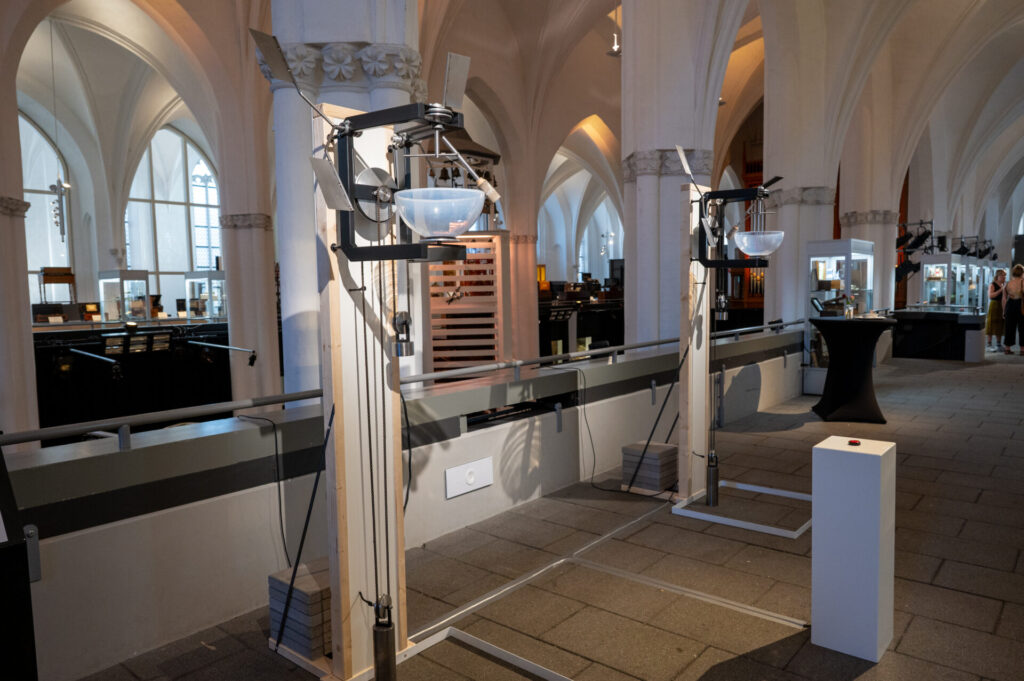
In the mechanical sound installation Binaural, artist Bart Schalekamp experimented with Emilio Timp and Jeroen van Veluw as the collective ZwartFrame to acoustically create tones using singing bowls. Inspired by the phenomenon of ‘binaural beats’, the installation produces two tones with a small frequency difference, creating a ‘beating’ effect. This experiment also led to an unconventional way of working with glass. In 2017, ZwartFrame created this installation in collaboration with Klinkklaar, a partnership between STEIM, Muziekgebouw aan ’t IJ, Beeldenstorm, EKWC, and the National Glass Museum.
‘Binaural’ was on display in our Art Hub from August 24 to November 5, 2023. Additionally, Schalekamp presented a new artwork in the Art Hub. In Fine Tuning, he explores the equilibrium of two tones and plays with the effect that occurs when they cross. The sound is like a rhythm in a composition that is slightly different each round. Due to different shapes and speeds of the wheels, there is no repetition, so the installation never sounds monotonous – or perhaps it does?
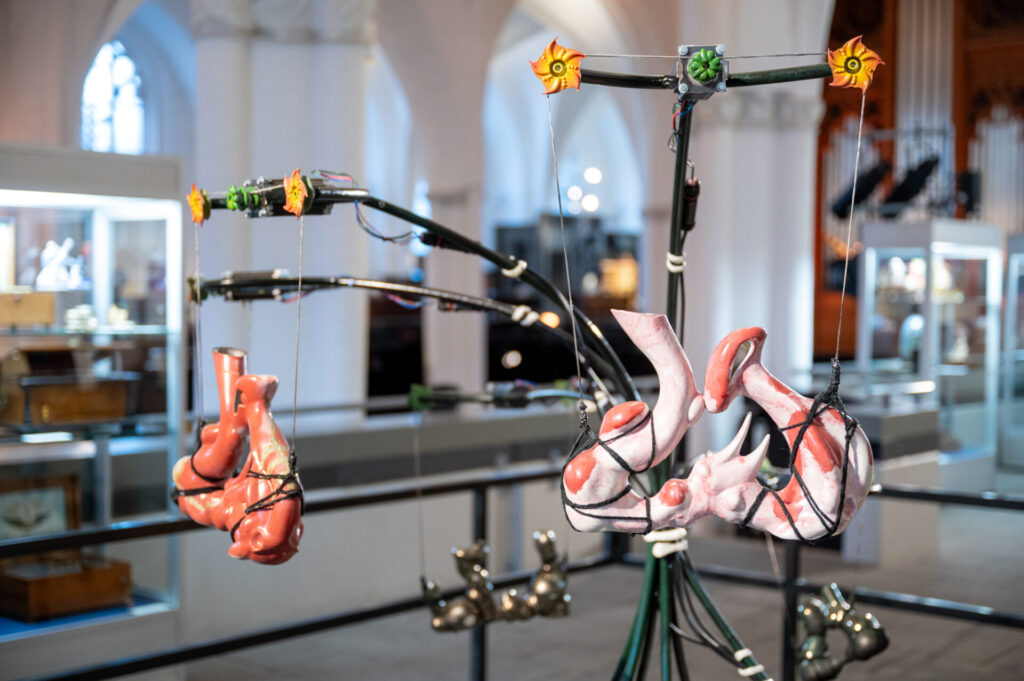
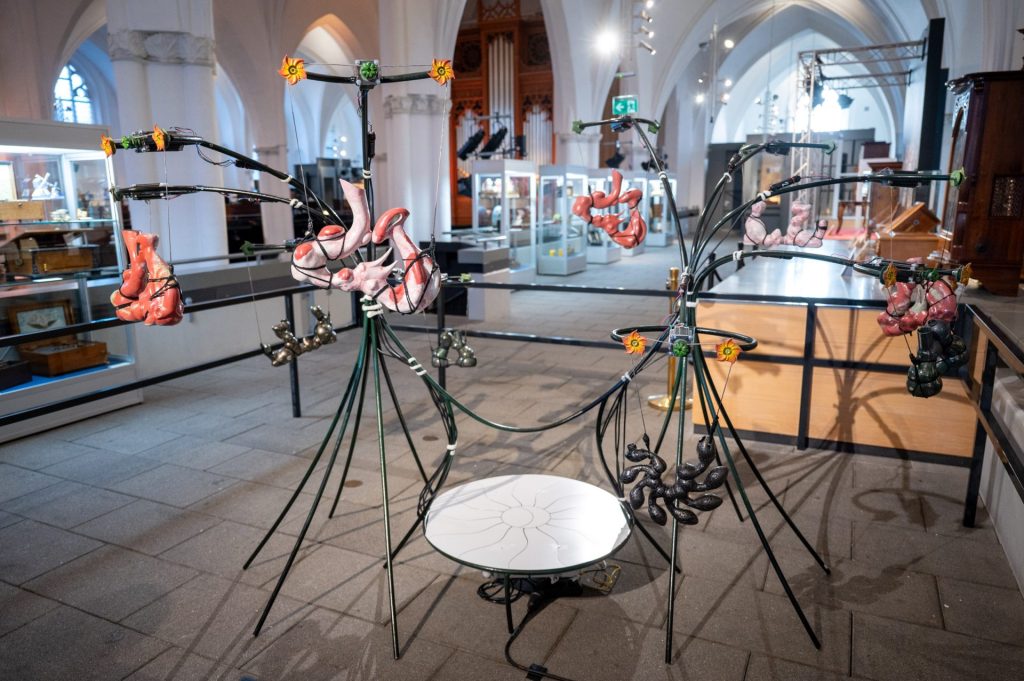
The sculpture Mitote by Mexican artist Vica Pacheco was part of the Gaudeamus Festival and on display in our Art Hub from September 7 to October 29, 2023. A collection of ceramic hydraulic flutes that Pacheco made at EKWC in Oisterwijk, the Netherlands, forms the basis of this kinetic installation.
‘Mitote’ is a term from contemporary Mexican popular culture used to describe a ruckus or a party. Previously, it was associated with a Mayan creation myth. In ‘Mitote’, Pacheco conceived a sculpture she calls the Bionic Mangrove, in which zoomorphic creatures produce their songs through the energy of the components of this tree.
Pacheco brings two worlds together. On one hand, she uses contemporary technology, such as electronic and digital tools. On the other, she draws on ancient techniques and materials, such as earth (clay), fire, air, and water. In her work, these opposites merge into a single whole, creating a kind of collaboration between past and present, ritual and technology.
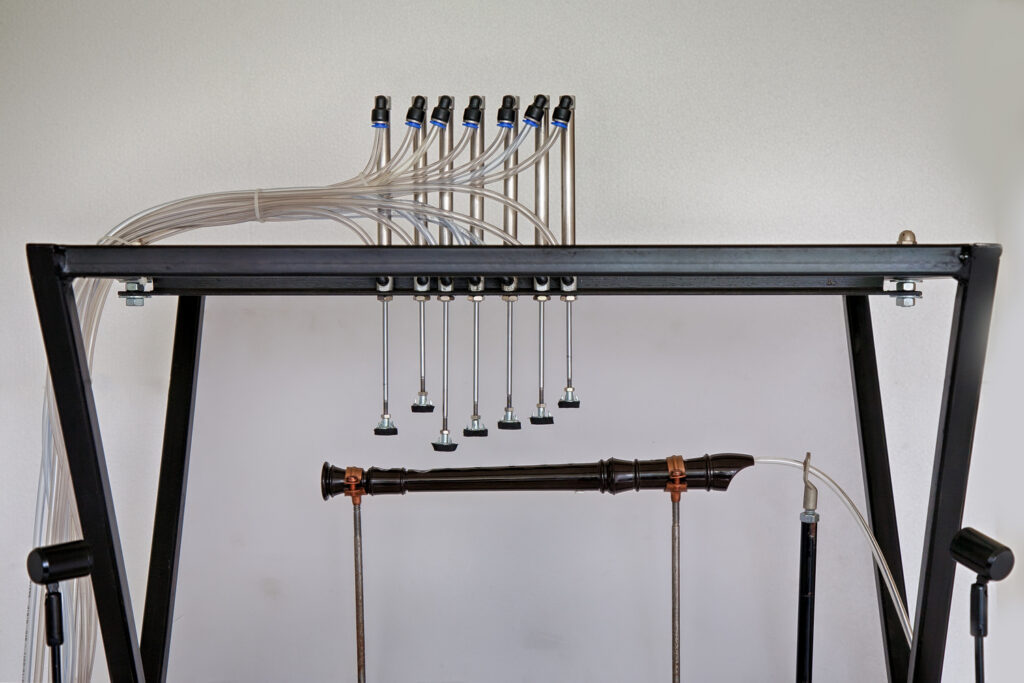
The Robot Flute by artist Casper de Jong explores whether Artificial Intelligence can respond to human emotions with music while simultaneously composing music based on our emotions. The Robot Flute does this by reading our faces and then creating a musical composition. As a pioneer in robots that translate human emotions into music, the artist chose to start with pure musical fundamentals, learning emotional composition on a recorder.
The robot begins with the basics of musical expression by learning how to play emotional music on a recorder. By linking human emotions to sounds, the work shows how technology and art are increasingly intertwined. At the same time, it raises questions about the role of machines in creative processes and whether artificial intelligence can truly replicate human feelings. The Robot Flute could be heard at Museum Speelklok from March to July 2023.
2022
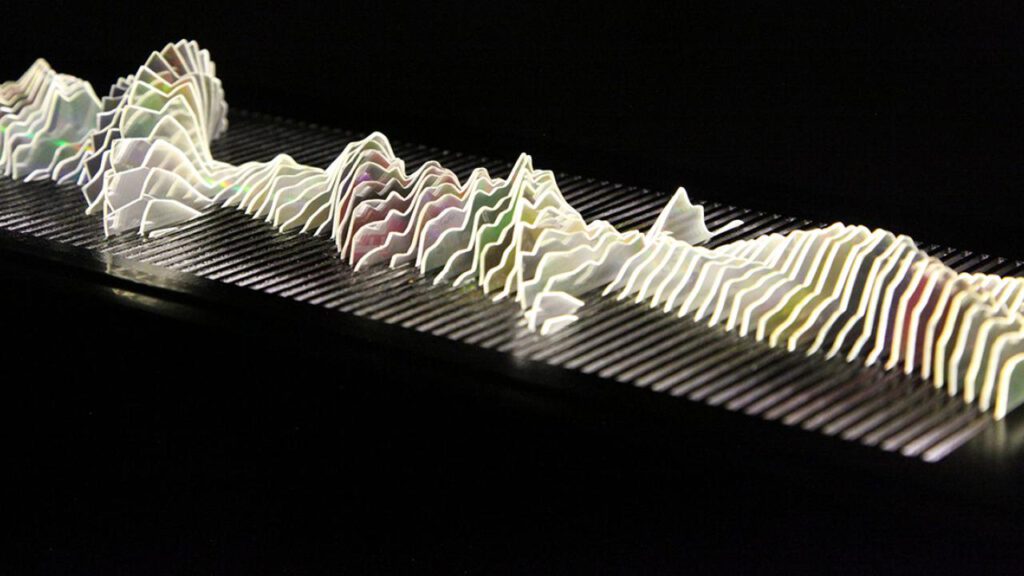
A music box made from 75 cut-up CDs, playable via a crank on the side. Canadian composer and digital artist Myriam Bleau created a modern version of the music box from old CDs. By turning the crank, you control the speed of the composition and whether it plays forward or backward. The music heard consists of fragments (samples) from different CDs. She draws from Swedish folk music, dated pop, and classical music.
Myriam Bleau’s works comment playfully on the intersection of music and technology. Her sound installation Stories of Mechanical Music was part of the Gaudeamus Festival and was on display in Museum Speelklok’s Art Hub in September 2022.
In 2022, the Art Hub opened on the Promenade in Museum Speelklok. This pilot offered space for local and international creators inspired by the museum’s music and technology.
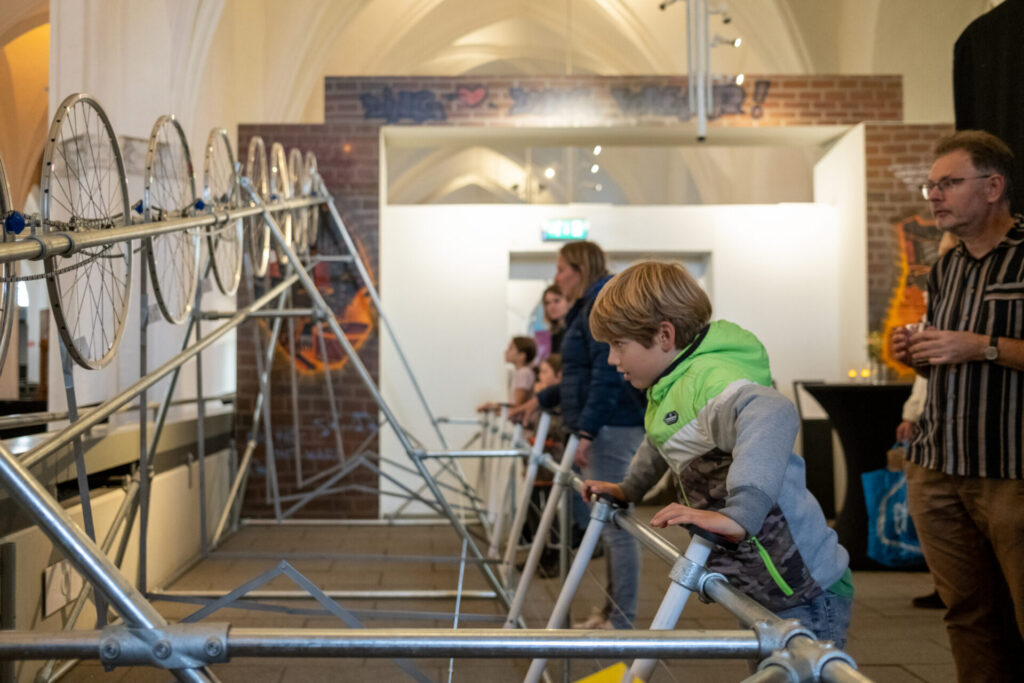
The opening, in collaboration with Springplank, also presented the winners of the first Springplank Award, a prize for young artists inspired by mechanical musical heritage. Daniel Simu and Yara Valente won the award for their concept for the three-meter-high Klappermobiel. The musical installation was first demonstrated on October 1. Visitors could set the three-metre-high ‘Klappermobiel’ in motion themselves by turning the pedal and pressing the coloured buttons. The harder you turn, the higher the sound. The Klappermobiel remained on display until the end of 2022.
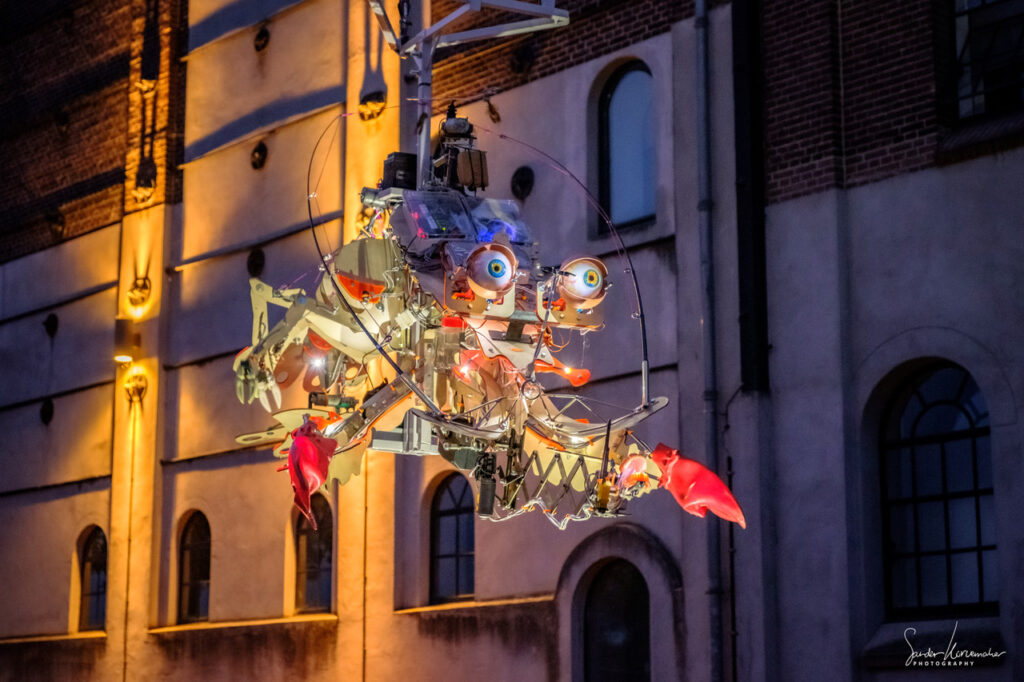
During the CareFull art event, an initiative by Art Utrecht, Tristan Kruithof’s work Animaltroniek was on display at Museum Speelklok. This interactive installation, blending technology, mechanics, and imagination, was placed in the museum café and activated via a sensor.
Kruithof uses robotics, electronics, and moving parts to create creatures reminiscent of animals from a fictional or futuristic world. The installation consists of mechanical ‘exotics’ that move autonomously and respond to their environment and visitors.
‘Animaltroniek’ reflects an above water world where robotics, mechanics, and electronics transparently merge to create ‘pettable’ creatures. The project is inspired by Animatronics, a discipline known primarily from film and television development.
Robots and robotics play an increasingly significant role in our society. Experiments occur physically and psychologically in technological imitation. What happens if this goes out of control and gains a life of its own? This project explores the tipping point in motion and visual language, making the human brain perceive it as realistic.
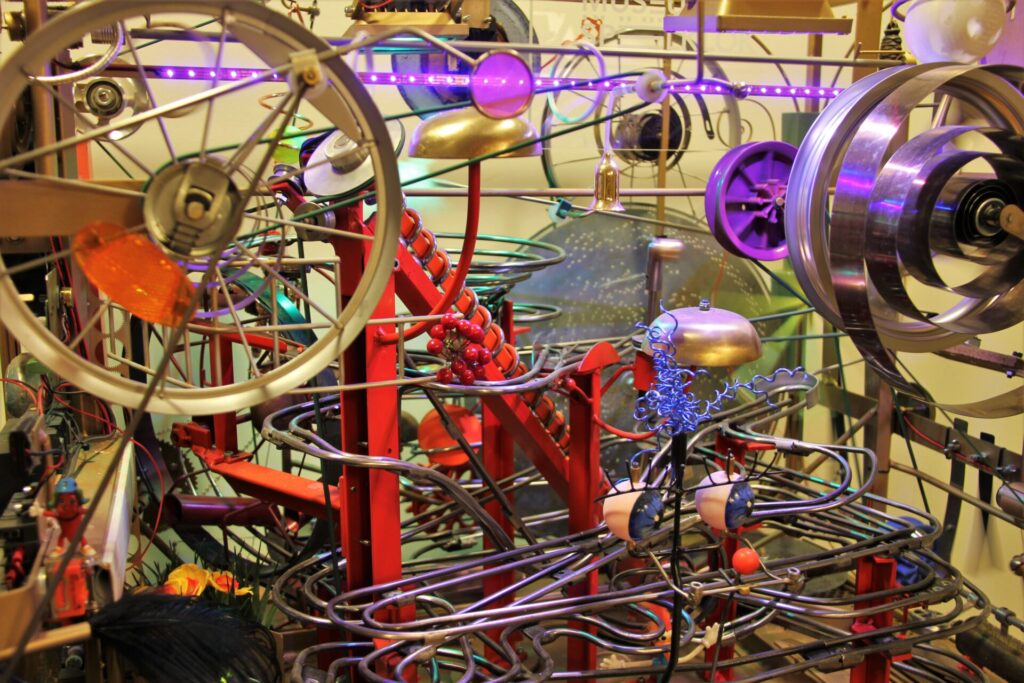
Artist Charles Morgan has an interactive artwork in the display case at the entrance of Museum Speelklok. To activate the work, hold your hand in front of the light sensors just below the case. Visitors can influence the artwork directly, creating an interaction between the public and the installation.
Charles Morgan combines the mechanical precision of Swiss clockmakers with absurdist humor reminiscent of Monty Python. The result is always a colorful moving artwork, often built around a central marble run to which ‘found objects’ are attached, moved by the marbles. The movement propagates through the entire work in a real chain reaction.
Museum Speelklok invited Charles Morgan to the museum and restoration studio. For his new artwork, he could select parts from a box of items collected over the years: gears, metal springs, organ pipes. Not historical material, but too valuable to discard. Morgan enthusiastically incorporated everything into the artwork, adding items from his own studio.
In 2017, the Friends of the Museum raised funds to acquire the artwork; since spring 2022, it has been displayed in the showcase on the museum’s exterior wall.
2021
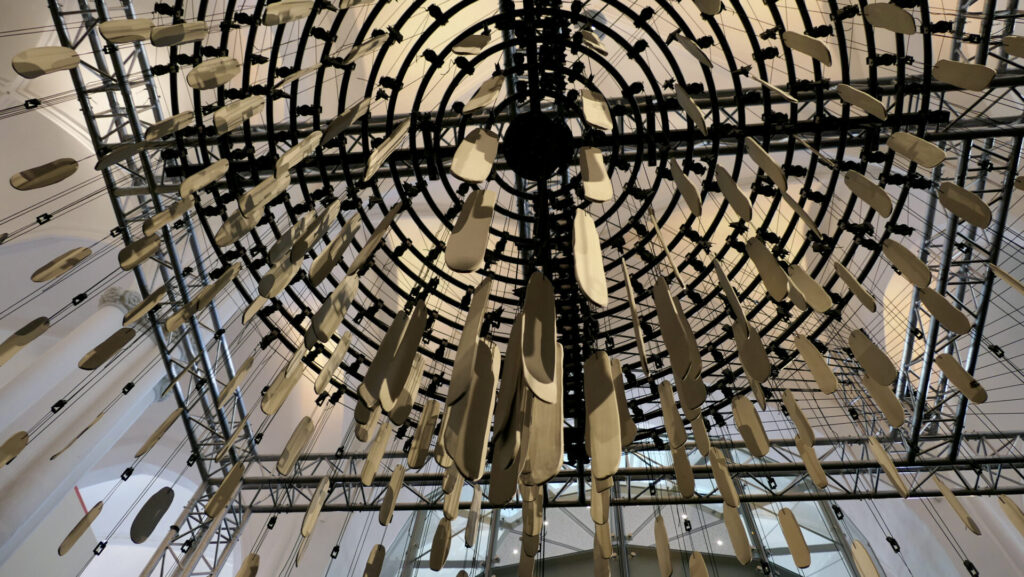
Aircilla is a collaboration between sound artist Gemma Luz Bosch and installation maker Jurriaan de Vos, combining their skills to create an interdisciplinary kinetic sound installation. Developed with Museum Speelklok, it was on display from July 1 to October 31, 2021.
‘Aircilla’ consists of 271 ceramic sound objects hanging from strings and set into motion by a large steel mechanism. The handmade objects swing and collide, producing sound in their own way, tone, and timbre. The hanging sound objects form a moving ‘swarm of sound’.
Each object, being handmade, moves uniquely. Each swings at a different frequency, rotates differently, and sounds different. The interplay of touching or almost touching, synchronously or asynchronously, creates a compelling visual experience.
2017
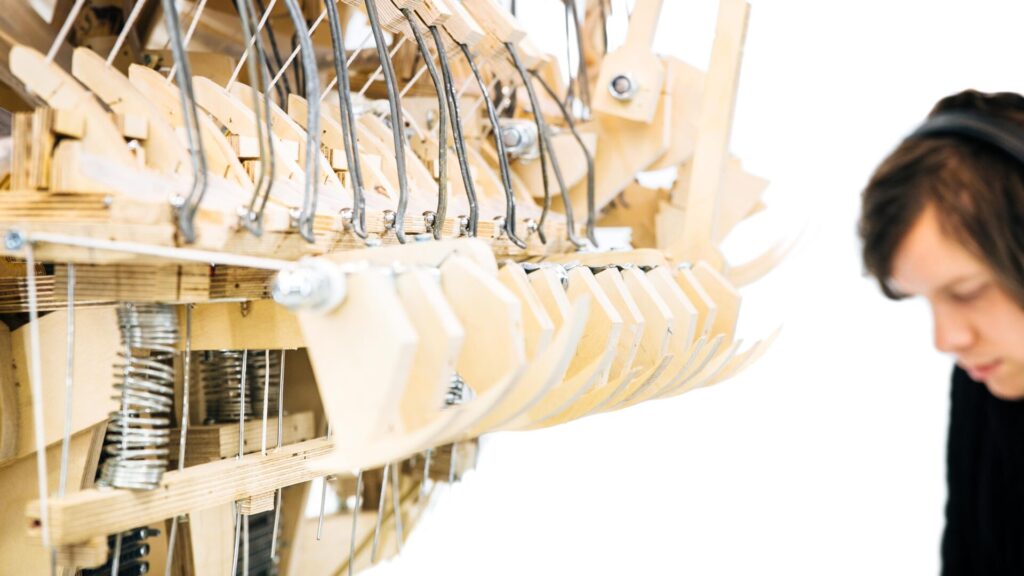
From June 1 to August 20, the famous Marble Machine by Swedish band Wintergatan was on display at Museum Speelklok. The video featuring this ingenious machine has been viewed over 277 million times on YouTube. The Marble Machine is a mechanical musical instrument that produces music using roughly 2,000 marbles. By turning a hand crank, the marbles are lifted through a complex system and then dropped onto various instruments, such as vibraphone, drums, and other percussion instruments, creating a fully mechanical piece of music. The Marble Machine returned to the location where it was conceived. Builder and band member of Wintergatan, Martin Molin, came up with the idea to build the machine during a visit to Museum Speelklok in 2014. After 14 months of work with 3,000 screws, numerous plywood sheets, and 2,000 marbles, the Marble Machine was complete! Wintergatan’s music focuses on mechanical musical instruments, ranging from driving beats to minimalist sounds.From June 1 to August 20, the famous Marble Machine by Swedish band Wintergatan was on display at Museum Speelklok. The video featuring this ingenious machine has been viewed over 277 million times on YouTube. The Marble Machine is a mechanical musical instrument that produces music using roughly 2,000 marbles. By turning a hand crank, the marbles are lifted through a complex system and then dropped onto various instruments, such as vibraphone, drums, and other percussion instruments, creating a fully mechanical piece of music.
The Marble Machine returned to the location where it was conceived. Builder and band member of Wintergatan, Martin Molin, came up with the idea to build the machine during a visit to Museum Speelklok in 2014. After 14 months of work with 3,000 screws, numerous plywood sheets, and 2,000 marbles, the Marble Machine was complete! Wintergatan’s music focuses on mechanical musical instruments, ranging from driving beats to minimalist sounds.